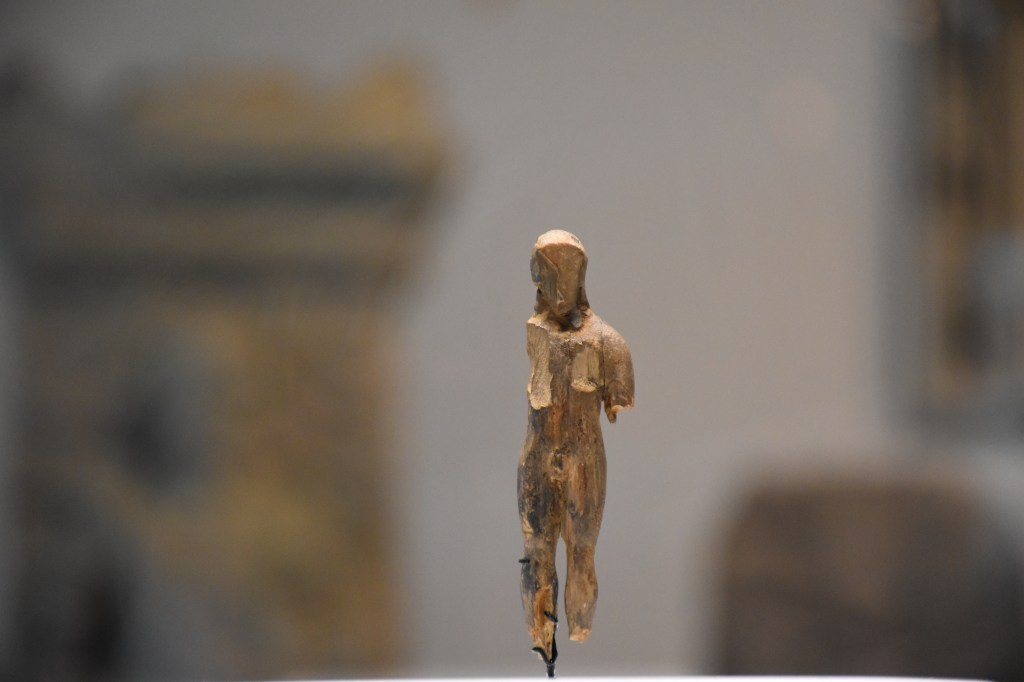
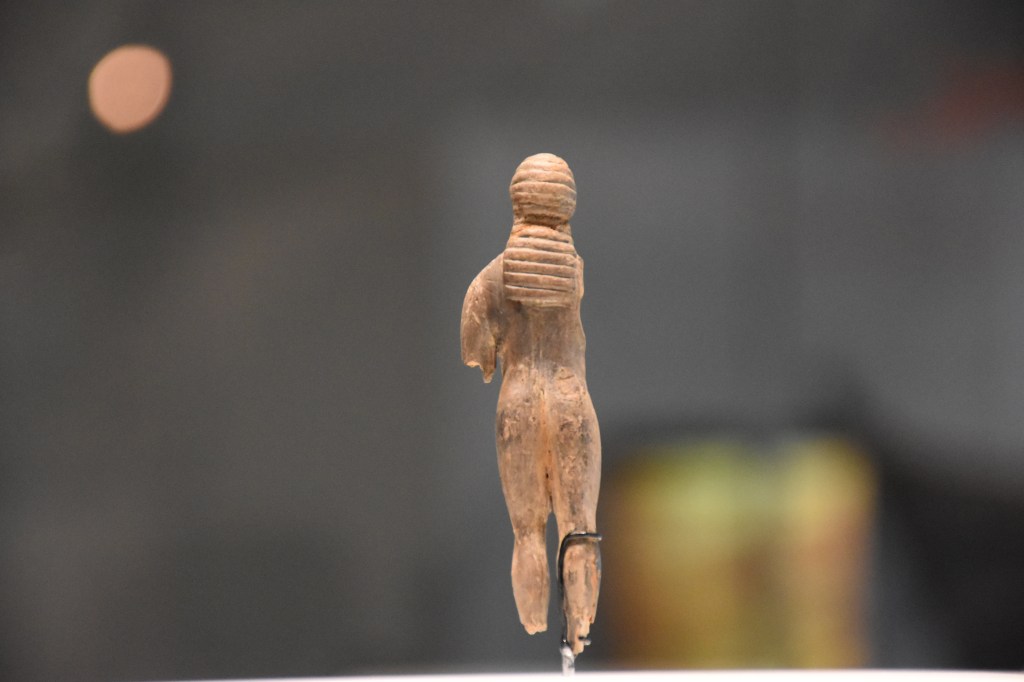
He stands only 9 centimetres high but he has presence. From the front he has powerful thighs, an impressive scrotum, you can see that his weight rests slightly on the left leg while the right leg and its knee extend slightly forwards. From the back, his stylised hair falls over his shoulders in rectangular plats. There is a beautiful roundness to his shoulders, buttocks, thighs, and calves. Even with the losses : the feet and ankles of both legs, the left arm and shoulder, the right arm from just above the elbow, the penis, the face – he is a true kouros, a powerpack of controlled energy.
The little kouros was discovered in 1973 at a dig situated behind the Bourse of Marseille, a nineteenth-century building from 1860 with a facade adorned with very fine classical sculptures by Auguste Ottin and Eugène Guillaume. The specific genus of wood has not been identified other than it has open pores rather than resinous, and is therefore probably a type of fruit tree, or oak, rather than pine. The figure entered the Musée de l’Histoire de Marseille in 1983 where it is displayed with a discrete mount attached to the left leg standing in isolation on a white modernist moulded platform in a large display case which, despite his small size, he dominates.
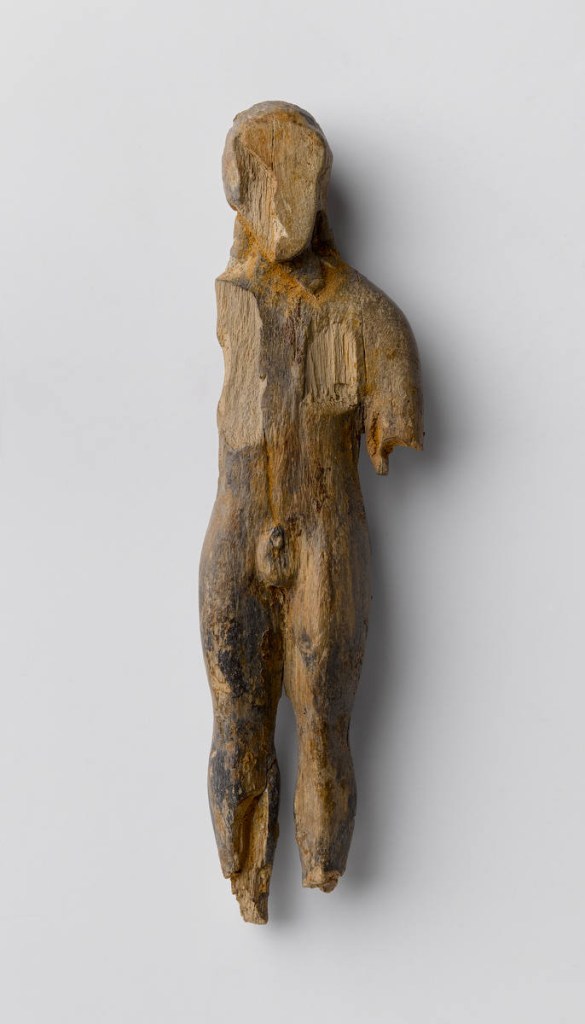
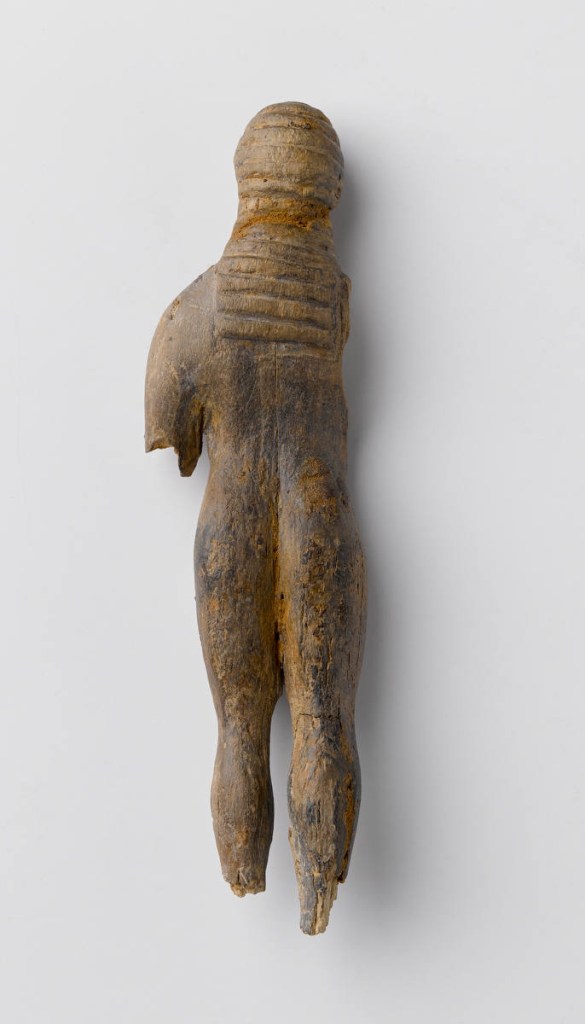
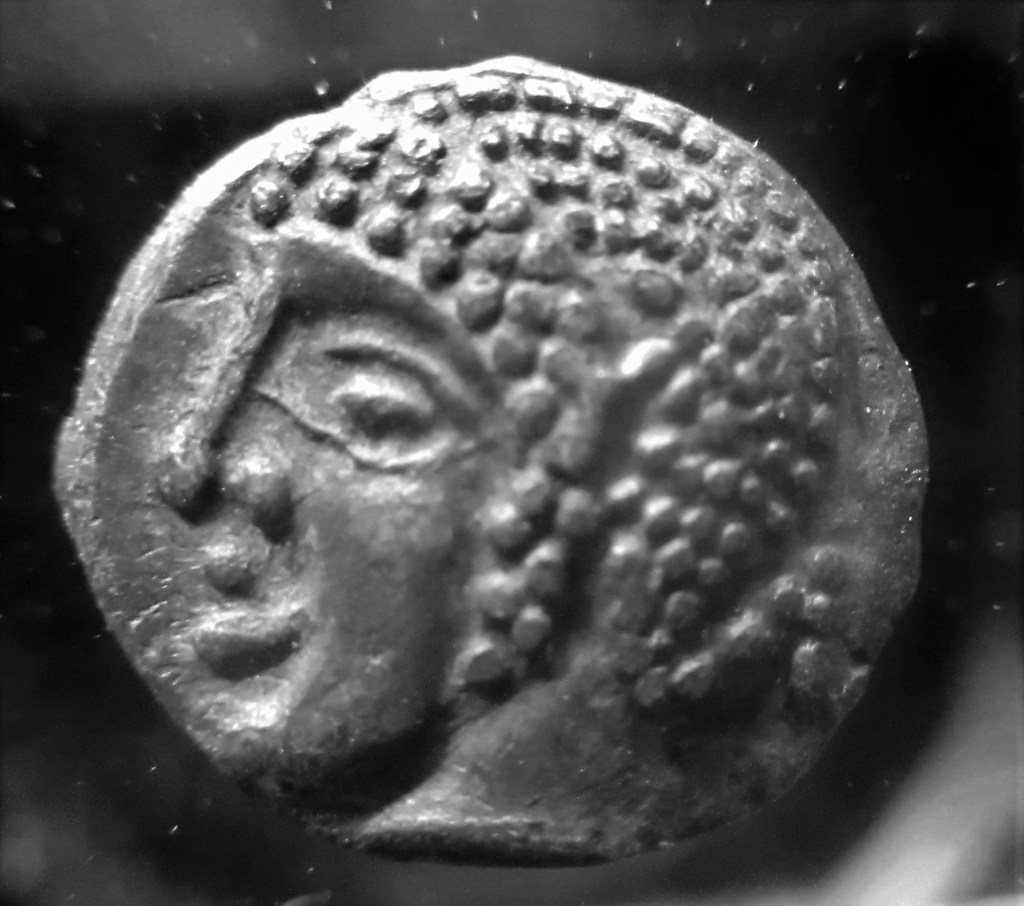
Discoveries of small wooden kouroi from anywhere in the Hellenic world are rare, to find one in Marseille is a major find. The figure is late archaic in style and has been dated to 550 BC, although it could perhaps be up to a hundred years later than this, as the stylised hair and the primitive powerfulness strongly resembles Marseille coinage of the 5th century, particularly the silver oboles with the heads of Apollo. It is reasonable to think that a late archaic style may have persisted a little longer in Marseille than in Athens or in older established colonies such as Syracuse. Marseille, in ancient Greek, MAΣΣA, was founded by Phocaean Greeks from the Ionian port-city of Phocaea on the West Coast of Anatolia (Foça in modern Turkey) in around 600 BC, and grew from an outlying trading colony into an important city. As with the coins marked MAΣΣA there can be little doubt that this little wooden kouros was, in a manner of speaking, ‘Made in France’.
Traditional histories of Western art always start out from exactly this point – the archaic kouros – before elaborating on the subsequent course of art: the breakthrough to perfection of the Classical period, the formal nihilism of the Hellenic period, the continuities combined with a steady decline in standards and taste with the Romans, the black hole of the Dark Ages, and the return to form with the Romanesque, the Renaissance, the Baroque, the Neo-classical, and then the academism and naturalism of the nineteenth century, through all of which, France, one of the great sculpture producing cultures in the world, excelled. And yet this little thing, this little wooden man, stands behind, or rather in front, of it all.
Not that there was not sculpture in France before the Greeks arrived. The palaeolithic venuses and chalcolithic statue-menhirs are beautiful and fascinating, but you cannot say of them, in the way of the kouros of Marseille, that they belong to the same lineage of art dependent on Greek forms and knowledge, which persisted in France across the centuries since the founding of Marseille, and from the sixteenth century was prioritised and made a self-conscious aim and objective of the French art. The anonymous geniuses of Romanesque and Gothic sculpture, Goujon and Pilon of the Renaissance, Pujet and Coysevox of the Grand Siècle, Pajou and Pigalle the Age of Enlightenment, Carpeaux, Rude, Rodin, and Maillol of the nineteenth century – none could have existed if not for this little kouros.
Perhaps if the wooden kouros of Marseille had been discovered in the nineteenth century he would have been more celebrated by art historians, artists and the public alike, but as it is just go and see him, unlike the Venus de Milo in the Louvre, there will be no crowds in front of what is arguably the most important sculpture in France.
Website of the Museum of the History of Marseille : https://musees.marseille.fr/musee-dhistoire-de-marseille-mhm
Object page at Musées de Marseille : http://collections.musees.marseille.fr/fr/search-notice/detail/d-1983-2-97-kou-5cda0?search=
Further reading : Antoine Hermary, ‘Un petit kouros en bois de Marseille (fouilles de la Bourse), Revue Archéologique, Nouvelle Série, Fasc. 2 (1997), pp. 227-242.
 Galerie Jamie Mulherron