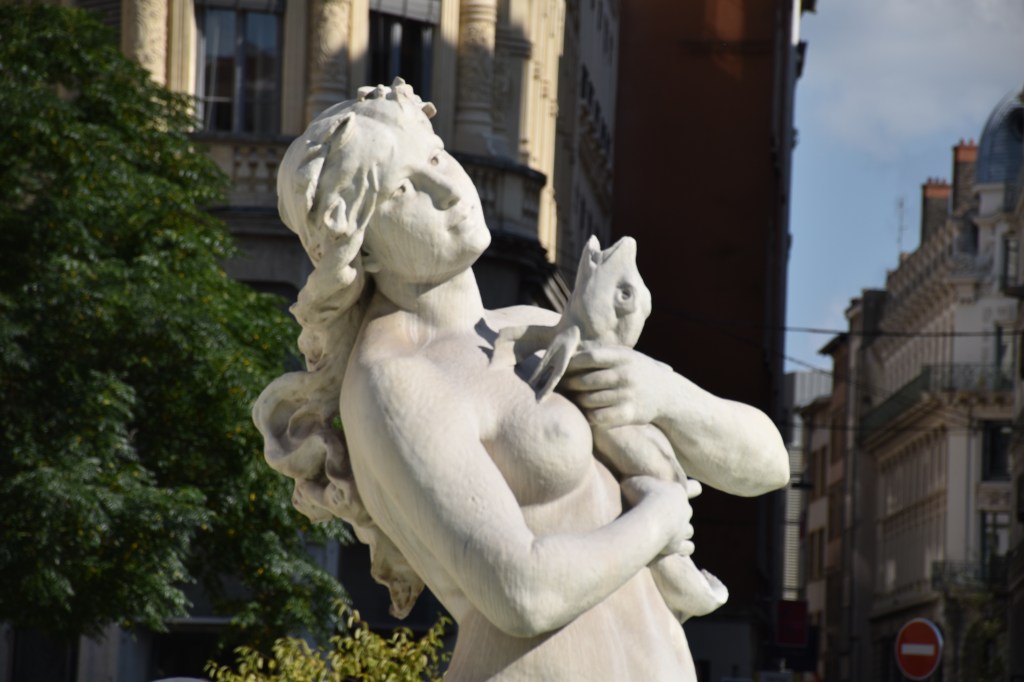
It is impossible to cross the Place des Jacobins in Lyon without noticing four nude women clasping spouting fishes between their breasts on the corners the basin of the fountain. While today it is easy enough to find information on the architect of the fountain as a whole, Gaspard André, and the sculptor, Charles Degeorge, responsible for the four portrait figures of Lyon artists who stand in the arcaded monument above and behind the Sirens – of the sculptor of the Sirens there is nothing to be found. You have to go back to the nineteenth century and a pamflet written by the fountain’s architect Gaspard André (using his pen-name ‘Joannès Mollasson’), to get the low down. In Notes Historiques sur la Fontaine des Jacobins, published in Lyon in 1886, only a year after the inauguratation of the fountain in 1885, André writes:
The preparatory contract with Charles Degeorge having been approved (17 October 1878), the Special Commission, in a sitting of 24 February 1879, occupied itself with the sirens, and proposed to confer their execution to ‘an artist who honours the French School of sculpture’, but on the condition that the marble carving is given to a specialist living in Lyon. As a consequence, and on the proposition of the architect of the fountain, Gaspard André, the Town contracted the Parisian sculptor Delaplanche, who has given us many justly appreciated works, among which our readers will no doubt remember, Music, Eve, and Maternal Education.
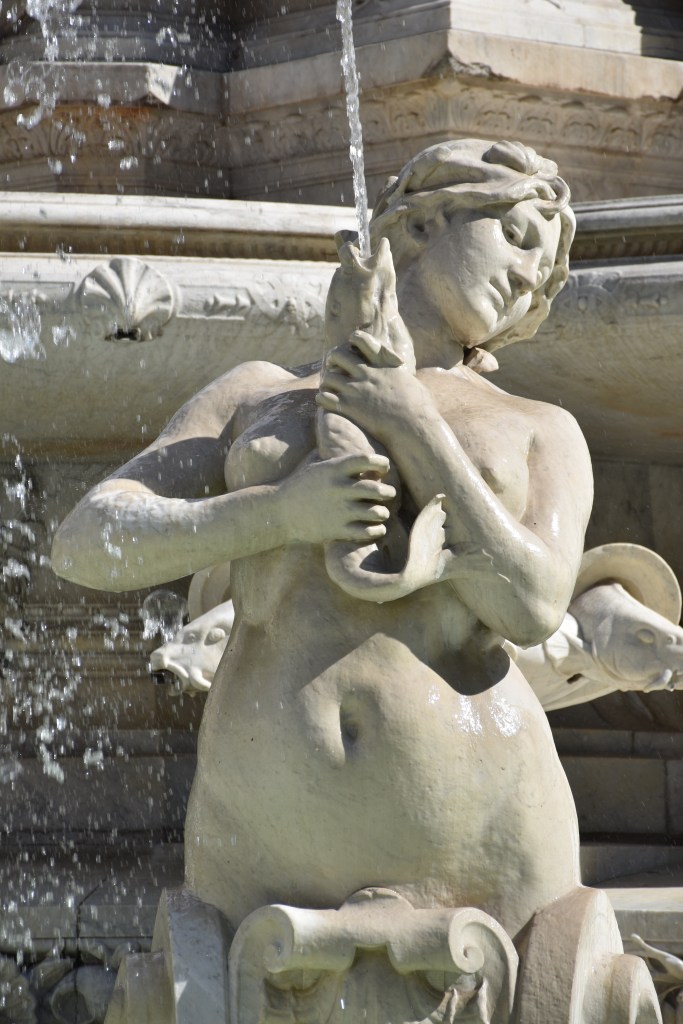
This Delaplanche, is Eugène Delapanche (1836-1891) born in Belleville in Normandy and who trained and worked in Paris. Of the famous sculptures by Delaplanche that André mentions Music is still to be seen at the Paris Opéra, Eve before the Fall at the Musée d’Orsay and Maternal Education in Square Samuel-Rousseau (a lovely square not too far from the Musée d’Orsay). Unlike Degeorge, who won a competition for the four figures of the Lyon artists, and who was a Lyon born and trained sculptor, Delaplanche had no particular connection with Lyon, and was simply awarded the commission for the Sirens – on the proviso that the actual carving of the marble took place in Lyon – on the advice of Gaspard André himself. Did André realise that while Degeorge was a worthy and competent sculptor he was also a very boring one (one need only site the aenemic pediment friezes by Degeorge in the courtyard of the Bibliothèque nationale), and that the fountain needed something to liven it up. Certainly Delaplanche was an inspired choice. The Sirens were put in place in 1884 before Degeorge’s four statues and the inauguration of the completed fountain in 1885 and from the outset they were admired by a slighty surprised Lyon public. Alluding to the voluptuous sensuality of the Sirens, André writes:
The Males of Lyon welcomed them warmly. The females of Lyon, even the best endowed, found them a little advantaged. For us they were excellent decorative figures …
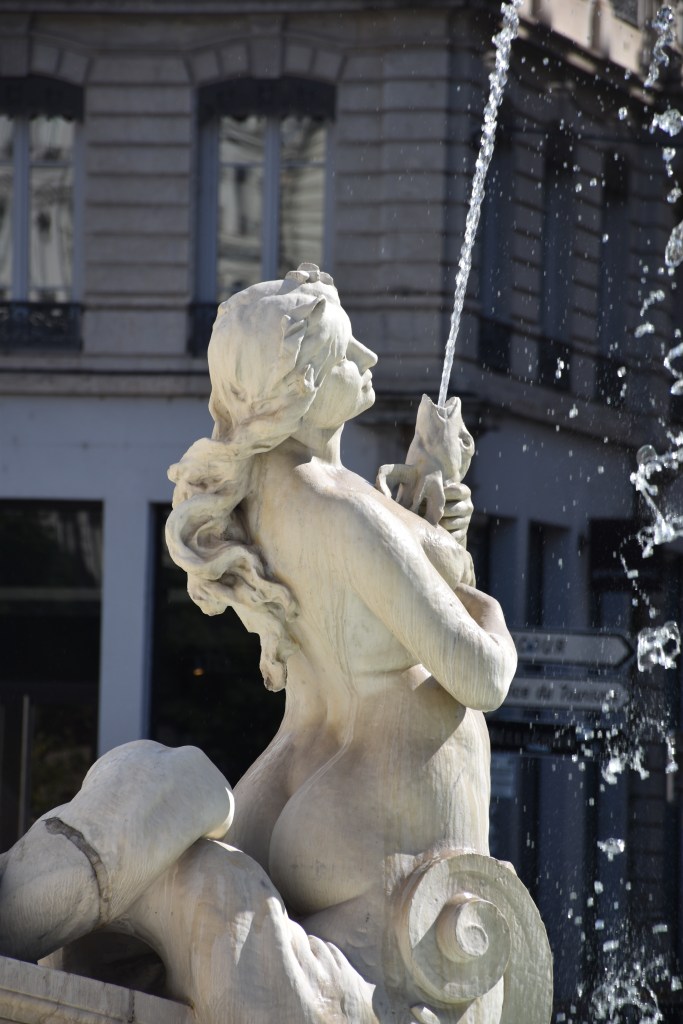
What was Delaplanche thinking when he conceived the models for these Sirens who serenely and firmly clasp fishes spouting jets of water between their breasts ? There is no particular iconographic correlation between the Sirens and the great Lyonnais artists which the fountain celebrates other than perhaps a vague reference to the two rivers upon which Lyon is built, the Saône and the Rhône. Nonetheless they completely transform what would otherwise have been a rather boring affair based on historical figues. Since 1884 it is Delaplanche’s sirens much more so than Degeorge’s artists who have caught the eye of Lyonnais and tourist alike as they walk across the Place des Jacobins.

