
MARCELLIN DESBOUTIN (Cérilly 1832 – Nice 1892)
Deux amants au temps de la Renaissance
1859
Huile sur toile, 81 x 101 cm
Monogrammé sur la pierre : MD / 1859
Cadre en bois doré
VENDU

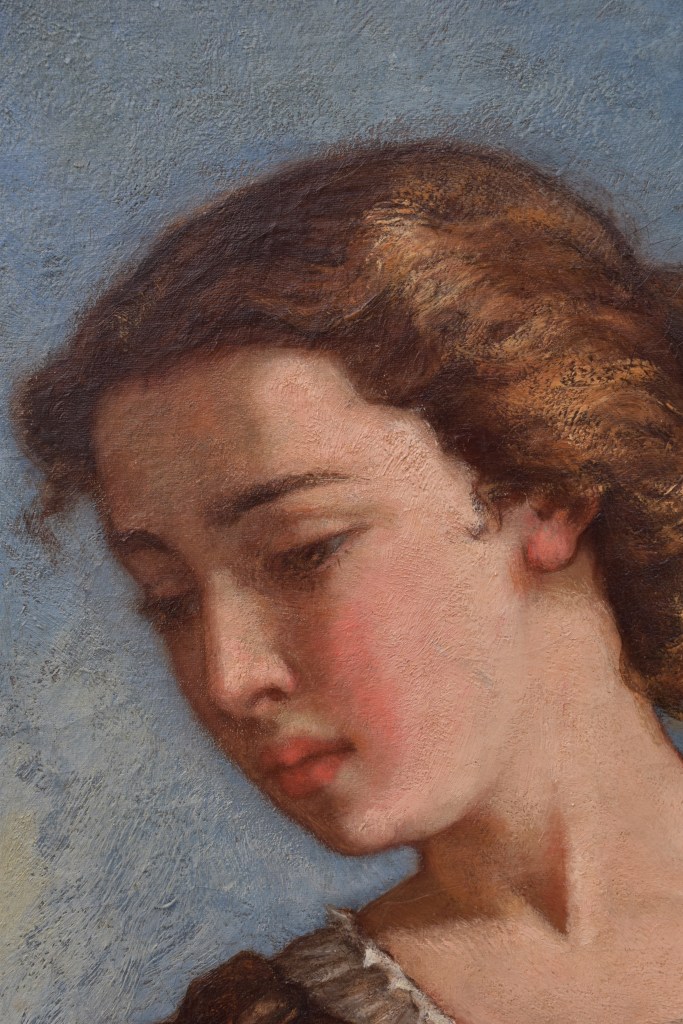
Situé sous l’ombre d’une vigne, un jeune homme, ténébreux et séduisant, présent à une jeune femme, belle et blonde, une lettre et une bague. Elle a l’air vraiment contrarié et il semble qu’elle vient à rejeter son offre. Ce couple intense et romantique est une pièce rare du séjour italien de Marcellin Desboutin, quand il vit à la Villa Ombrellino près de Florence, une grande baraque qu’il acheta en 1857. Son biographe, Noël Clément-Janin, ne commence que la liste des tableaux à partir de l’année 1860, et, par ma connaissance, la seule autre toile par Desboutin datant de cette période est la très belle Femme et enfant peint vers de 1858, dans la collection Palazzo Pitti-Galleria d’arte moderna à Florence.
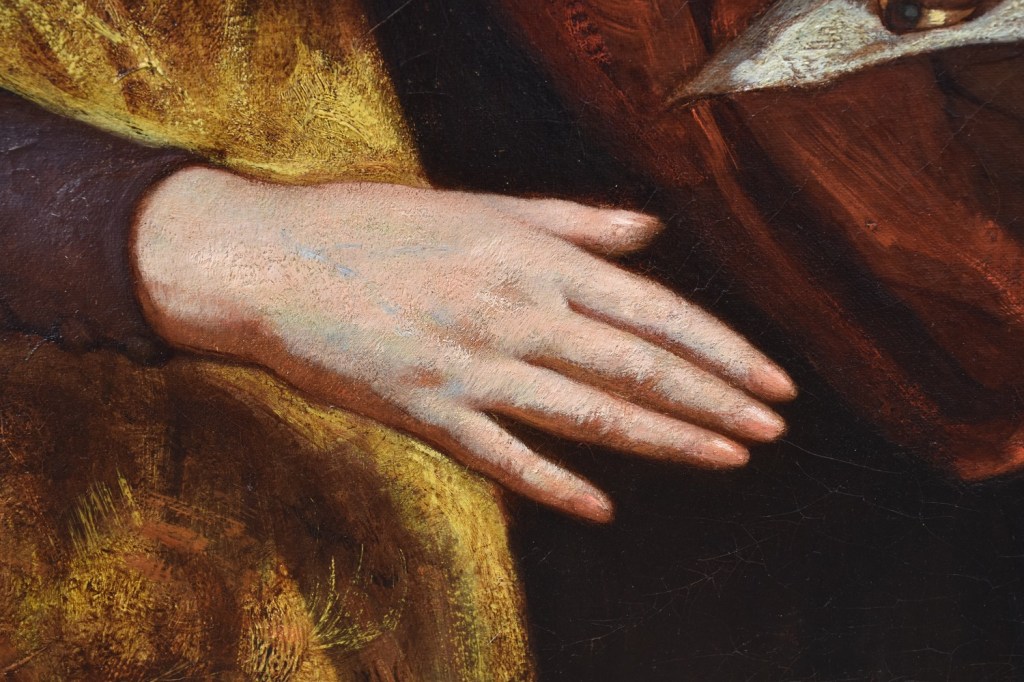
La forme et le sujet constate l’intérêt de Desboutin dans l’art italien de la renaissance, et c’était à cette époque, avant sa chute financière, que Desboutin eut à l’Ombrellino une grande collection de vieux maîtres. Mais, même s’il habitait à Florence, comme coloriste (il était élève de Thomas Couture), c’était aux peintres vénitiens, et surtout le Titien et Véronèse, à qui il regardait. Plus tard, ami de Manet et Degas, Desboutin participe à la deuxième exposition des impressionnistes en 1876, et d’une certaine façon, ce tableau témoigne d’un rapport entre le romantisme français et l’impressionnisme. Voir, par exemple, les veines de la main de la jeune femme peints en bleue ciel.
On doit consacrer quelques mots à ce sujet intéressant si plutôt difficile à déterminer. Malheureuse, la jeune femme lui détourne la tête, et ses gestes indiquent qu’elle ne veut pas recevoir la bague et la lettre. En même temps, le jeune homme un peu stoïque reste aussi très sympathique. Il y a une tendresse touchante entre les deux, ils sont très proches l’une de l’autre, et il a la main autour de la taille de sa partenaire. Sans doute les jeunes sont amoureux, mais est-ce que la bague et la lettre sont de lui ou peut-être d’un autre ? Desboutin a réalisé une situation et les émotions complexes avec les gestes et les beaux visages des deux protagonistes. Malheureusement, il n’a pas été possible d’identifier avec certitude le sujet du tableau quoique c’est clairement un sujet littéraire, et on doit se souvenir que Desboutin était aussi un dramaturge et un poète. Une suggestion pourrait être qu’ils représentent le Paolo et Francesca de Dante, où Paolo livre à Francesca une lettre et un anneau au nom de son méchant frère Giovanni.
Au cours de sa carrière, Desboutin utilisait quelquefois le monogramme avec le M connecté au D, et au-dessous une ligne, la date. Ce tableau inédit de Marcellin Desboutin est une découverte très importante pour notre connaissance de cette grande artiste.

Sur la condition, la toile n’a jamais été rentoilée et en conséquence, elle a subi d’une réduction de la tension, les bordes sont fragiles et il y a une déchirure qui traverse le corps de la jeune femme. En revanche, la toile, le châssis, la couche picturale, tous sont originaux et préservés. La couche picturale reste dans une condition exceptionnelle avec tous les empâtements et les coloris forts pour apprécier le pinceau vibrant de Desboutin.

Bibliographie
Noël Clément-Janin, « Desboutin à l’Ombrellino », La Renaissance de l’art français et des industries de luxe, no 8, août 1919, p. 341-346
Noël Clément-Janin, La Curieuse Vie de Marcellin Desboutin, Paris 1922
Marcellin Desboutin (1823-1902). À la pointe du portrait, sous la direction de Maud Leyoudec et Alexandre Page. Ouvrage édité à l’occasion de l’exposition à Moulins, musée départemental Anne-de-Beaujeu, 20 octobre 2018 – 15 septembre 2019

English : Set in the shadow of a hanging vine, a young dark and handsome man presents a ring and a letter to a beautiful blonde young woman. Upset, she seems to reject his advances. This intense Romantic couple is a rare work from Marcellin Desboutin’s Italian period when he lived at the Villa Ombrellino near Florence, a large country house he had bought in 1857. His biographer, Clément-Janin, only begins to catalogue the paintings starting from 1860, and to the best of my knowledge, the only other canvas by Desboutin dating from the late 1850s is the beautiful Mother and Child, painted in about 1858, which is in the collection of the Palazzo Pitti-Galleria d’arte moderna in Florence.
The form and the subject matter of our painting are evidence of Desboutin’s interest in the art of the Italian Renaissance, and it was exactly at this period, before his financial troubles, that Desboutin owned an important collection of Old Master paintings at the Villa Ombrellino. However, even if he lived in Florence, as a colourist, it was to the Venetians, and above all to Titian and Veronese, that Desboutin looked. Later, Desboutin, a friend of Manet and Degas, would participate in the Second Exhibition of the Impressionists in 1876, and Deux amants au temps de la Renaissance represents an interesting bridge between French Romanticism and Impressionism. See, for example, the veins of the hand of the young woman painted in sky blue, which is an extraordinary detail.
The subject of the painting is interesting if difficult to determine. Clearly unhappy, the young woman turns her head away from the young man and her gestures suggest that she does not want to receive the ring and the letter. At the same time as the young man seems stoical he is also sympathetic. There is a tenderness between the two, they are close to each other, and he has his hand around her waist. Without doubt the young couple are in love, but is the letter and the ring from the young man himself, or perhaps another who he is standing in for? Unfortunately it has not been possible to identify the subject of the painting with any certainty, even if it is clearly a literary one – and one should remember that Desboutin was also a playwright and poet. One suggestion could be that they represent the Paolo and Francesca of Dante, where Paolo presents to Francesca a proposal of marriage and an engagement ring on behalf of his evil brother Giovanni. But whatever the exact litary reference may be, Desboutin has created a complex situation with complex emotions through the gestures and the beautiful faces of the two protagonists.
Over the course of his career Desboutin would sometimes use a monogram, as here, of an M joined to a D, and beneath a dividing line, the date. This painting by Desboutin was previously unknown and is a very important discovery for our knowledge of the artist.
On the condition, the canvas has never been relined and consequently has lost tension, the edges are weak, and there is a tear across the body of the young woman. On the other hand, the canvas, the stretcher, and the picture layer, are all original and well-preserved, and importantly the paint surface remains in exceptionally good condition, with the impastos and the strong colours intact to be able to fully appreciate Desboutin’s vibrant brushwork.
Galerie Jamie Mulherron – Sculptures et peintures du 19e siècle – Lyon
Tél : 06 33 27 50 09 | Courriel : mulherron@orange.fr
 Jamie Mulherron