
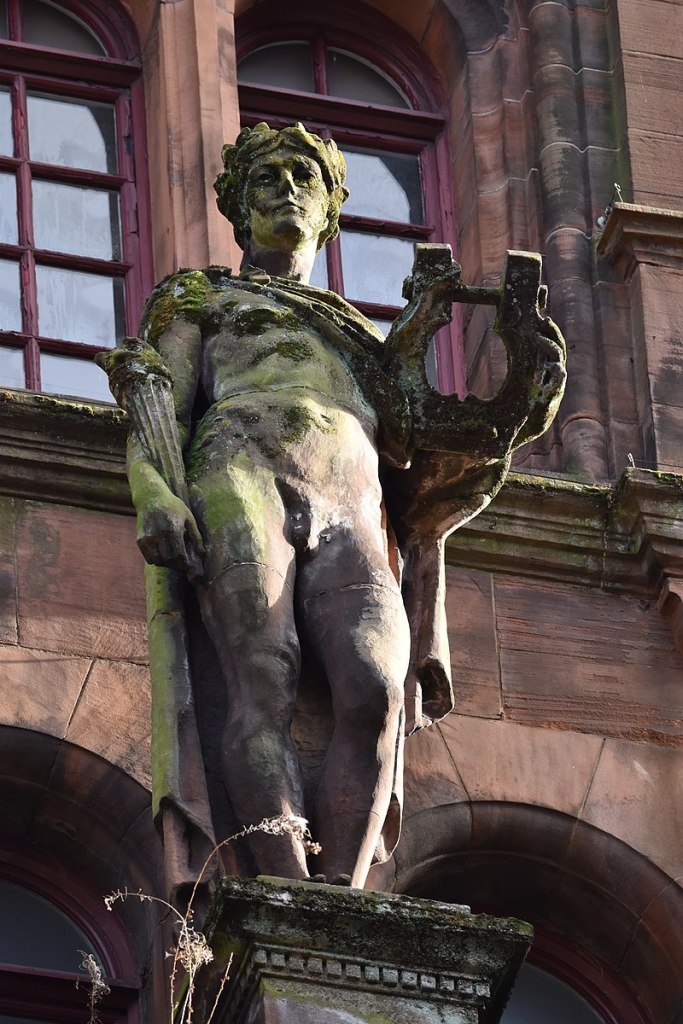
Perched high on a pediment on the Renfield Street side of the former Sun, Fire and Life Insurance Company building in Glasgow, stands an imposing classical nude figure of Apollo, holding a flaming torch, reminiscent of a giant ice cream cone, in one hand, and a lyre in the other. His idealised body contrasts with a distinctive and naturalised pinched wee face. Patches of green moss grow, not unattractively, over his skin and weeds spring around his feet.
Flanking him on his left is a powerfully built allegorical figure of a bearded older man pulling a cowl over his head representing ‘Night’, and to his right an equally muscular female figure who appears to be doing the opposite, representing ‘Day’, both owing much to Michelangelo’s sculptures of Dawn and Dusk from the tomb of Lorenzo de’ Medici in Florence.


William Birnie Rhind created these, and a number of other sculptures, for the new head office of the Sun, Fire and Life Insurance Company between 1889 and 1894, and his figure of Apollo, Greek god of the sun, is the artistic soul of the building.
Almost as soon as the red sandstone edifice, designed by William Leiper, and Rhind’s sculptures were complete, it was recognised as a Glasgow masterpiece. The arts magazine The Artist in February 1895 describes it in the following terms :
Glasgow has just added one of the most artistic buildings it is possible to imagine, in the new offices of the Sun Fire and Life Assurance Company, at the corner of West George Street and Renfield Street. The building has been designed by Mr. W. Leiper, in the sixteenth-century French Renaissance style, and being constructed of red stone, presents an imposing appearance. Both frontages carry a large amount of high-class sculpture, executed by Mr. William Rhind, of Edinburgh, and it is this sculpture which distinguishes this building from all others around. Thus the capitals of the street floor are emblematic of the signs of the Zodiac, and there is a splendidly executed figure of Apollo, and others of Day and Night, surmounting the pediment on the Renfield Street frontage. The treatment of the upper stories follows that of the chateaux of France, with enriched dormers, giving the building the broken sky-line which is characteristic of this style of architecture. The main entrance is at the angle of the building, and forms the basement of a large octagon, which is crowned by a domed roof and lantern. Taken as a whole this is the most artistic of Glasgow’s business houses. (The Artist, February 1895, p. 77)
Next time you’re wandering down Renfield Street take a look up at the Glasgow Apollo and his heavenly companions.

 Jamie Mulherron